Surf Spey Trajectory Mechanics & Science
Surf Spey Launch AnglesBy Mark Severino
Trajectory MechanicsDefinition
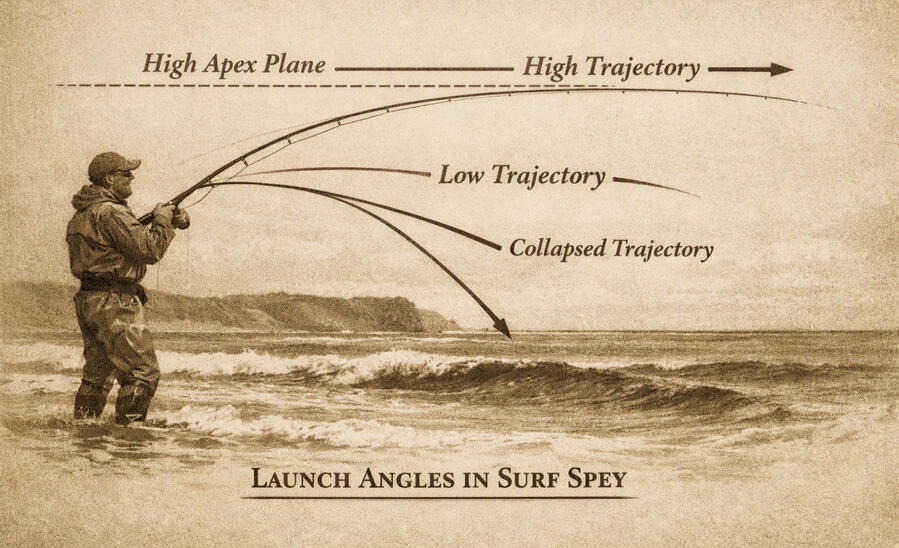
Trajectory is the geometric direction of the forward leg at the moment of the stop. The forward leg is the front segment of the fly line that travels away from the caster after the stop and forms the upper portion of the loop. Trajectory is the forward continuation of the apex plane and determines loop height, turnover stability, and distance ceiling.Trajectory is not pointing.
It is the top hand following and maintaining the apex plane through the forward stroke.The rod tip travels along the geometric path already established by apex formation; the top hand’s role is to preserve that plane, not to aim or direct it.Trajectory emerges from apex continuity, not from caster intent.Apex Plane = Trajectory Plane
The apex plane sets the launch plane.Apex geometry determines:
• launch height
• launch direction
• usable acceleration corridor
• loop stabilityHigh apex → high trajectory; level apex → level trajectory; dropped apex → low trajectory; forward apex → collapsing trajectory
Trajectory is the apex plane expressed in forward flight.Stroke Plane Alignment
Trajectory is the continuation of the stroke plane.Correct stroke plane:
• chest shoulder seam
• level apex plane
• linear translation
• late rotationIncorrect stroke plane:
• center chest path
• dipped tip
• tilted apex
• early rotation
Stroke plane errors directly distort trajectory.Late Rotation → Launch Vector
Rotation sets the launch vector.
Late rotation:
• compresses the loop
• preserves apex height
• stabilizes trajectory
• increases distance ceilingEarly rotation:
• dips the tip
• opens the loop
• lowers trajectory
• collapses under wind
Trajectory is a rotational consequence.
Stop Event → Trajectory Lock-In
The stop locks trajectory.A crisp stop:
• preserves tip path
• stabilizes loop height
• maintains forward vector alignmentA soft stop:
• sags the belly
• lowers trajectory
• destabilizes loop geometryTrajectory is fixed at the stop and cannot be corrected afterward.Wind & Trajectory Interaction
Trajectory determines aerodynamic stability in air, not water.
High, level trajectories resist:
• headwind
• crosswind
• shear
• gusts
• lateral wind drift
Low trajectories collapse under wind force.Waves influence geometry before the cast, not trajectory during the cast.Doctrine
Trajectory is the geometric continuation of the apex plane and the aerodynamic launch angle of the forward leg. Apex geometry, stroke-plane alignment, late rotation, and a crisp stop create it.High, level trajectories are required for surf stability, loop preservation, and maximum distance.

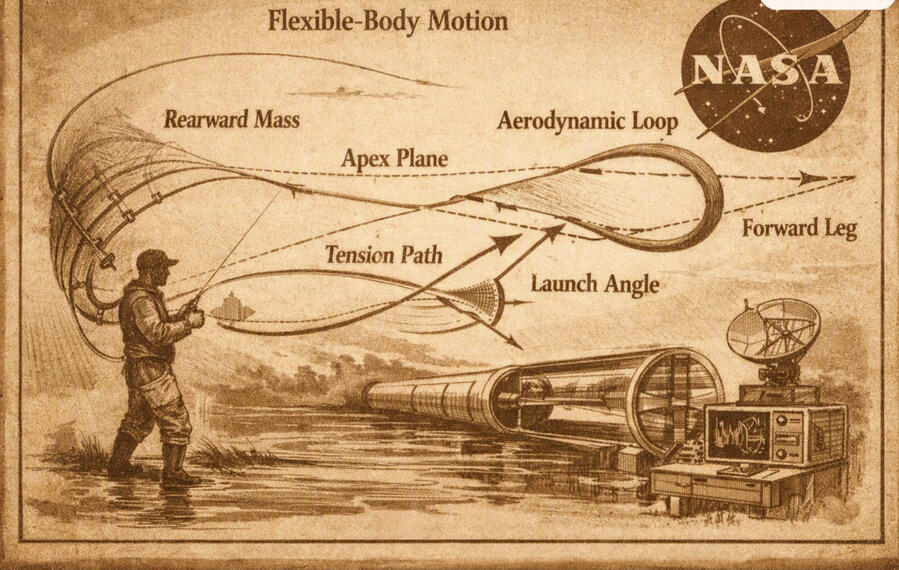
TRAJECTORY SCIENCEThe Aerodynamic, Flexible Body, and Tension Path Physics of Surf SpeyDefinition
Trajectory is the aerodynamic launch angle of the forward leg created at the stop. The forward leg is the front segment of the fly line that travels away from the caster after the stop and forms the upper portion of the loop.Trajectory is the forward continuation of the apex plane and the directional expression of the energy stored in the rearward mass.Trajectory is not aiming. It is physics.Research Citations
• Gatti Bono, C., & Perkins, N. (2004). Physical Model of the Fly Casting Loop. NASA/CR 2004 213201.
• Spolek, G. (1986). The Mechanics of Fly Casting. Journal of Sports Sciences.
• Lingard, S., & Smith, C. (2002). Flexible Body Dynamics in Tensioned Filaments. Proc. Royal Society A.Apex Plane = Trajectory PlaneThe apex plane is the high, rearward, level rod tip plane established by Drift and Slide. The trajectory plane is the forward continuation of that same plane at the stop.They are one plane expressed across two phases:
• Apex plane → rod tip path at maximum height
• Trajectory plane → rod tip path at launchTrajectory cannot exceed or correct apex geometry. Trajectory is not pointing - it is following the apex plane.Research Citations
• Perkins, N., & Marshall, J. (2004). The Role of Tip Path Geometry in Loop Formation. Journal of Biomechanics.
• Gatti Bono & Perkins (NASA). Loop Aerodynamics and Tip Path Continuity.
• Spolek (1986). Rod TipAerodynamic Principles
Trajectory governs the loop's aerodynamic behavior in flight.
It determines:
• loop height
• flight duration
• drag profile
• collapse resistance
• forward vector stabilityHigh, level trajectories reduce drag and maintain loop geometry. Low or tilted trajectories collapse under aerodynamic load.Trajectory is the aerodynamic expression of the apex plane.
Research Citations
• Gatti Bono & Perkins (NASA). Aerodynamics of Fly Casting Loops.
• Marshall, J., & Perkins, N. (2005). Drag and Loop Stability in Fly Casting. Journal of Fluids and Structures.
• Spolek (1986). Aerodynamic Collapse Modes in Fly Line Loops.Flexible Body Mechanics
Fly line behaves as a flexible, tensioned body - not a rigid projectile.Trajectory governs:
• forward leg stability
• belly sag
• loop propagation speed
• collapse modesOnce the stop occurs, the forward leg follows the tension path already built. The trajectory cannot be corrected after the stop because the flexible body is already committed to its direction of travel.Research Citations
• Lingard & Smith (2002). Flexible Body Propagation Under Tension.
• Perkins & Gatti Bono (NASA). Dynamic Behavior of Tensioned Filaments.
• Spolek (1986). Fly Line as a Flexible Body in Motion.Tension Path Physics
Trajectory is the directional release of stored tension.The tension path is:
Anchor → D Loop → Apex → Stroke Plane → Stop → TrajectoryEach link sets the next. Trajectory is the final expression of this chain.
Misalignment anywhere in the tension path produces predictable trajectory failures:
• dropped apex → low trajectory
• forward tilted apex → collapsing trajectory
• early rotation → dipped tip → open trajectoryTrajectory is the geometric consequence of the tension path.
Research Citations
• Perkins & Marshall (2004). Energy Storage and Release in Fly Casting.
• Gatti Bono & Perkins (NASA). Tension Path Continuity in Loop Formation.
• Spolek (1986). Anchor and D Loop Geometry Effects on Trajectory.Rotational Dynamics
Rotation determines the launch vector of the forward leg.
Late, crisp rotation produces:
• vertical tip path
• compressed loop
• high trajectory
• aerodynamic stabilityEarly rotation produces:
• dipped tip
• open loop
• low trajectory
• collapse under aerodynamic load
Rotation releases stored energy along the apex plane. Trajectory is the aerodynamic continuation of that release.Research Citations
• Marshall & Perkins (2005). Rotational Energy Release in Casting.
• Spolek (1986). Tip Path Rotation and Loop Formation.
• Biomechanics literature: Angular Momentum Transfer in Sports Motions (various authors).Doctrine
Trajectory is the aerodynamic continuation of the apex plane. Flexible-body mechanics, tension-path physics, and rotational dynamics govern it. Trajectory is not pointing - it is following the apex plane. High, level, tension-driven trajectories maximize stability, preserve loop geometry, and extend distance.